What it is
Some of my storytelling work leans on heavy AI models for video, lip sync and voice. That work runs on GPUs I do not keep on my desk, so I built a few quiet tools around it. They are not products; they are the workbench. I group them here as my home AI lab.
ComfyBridge
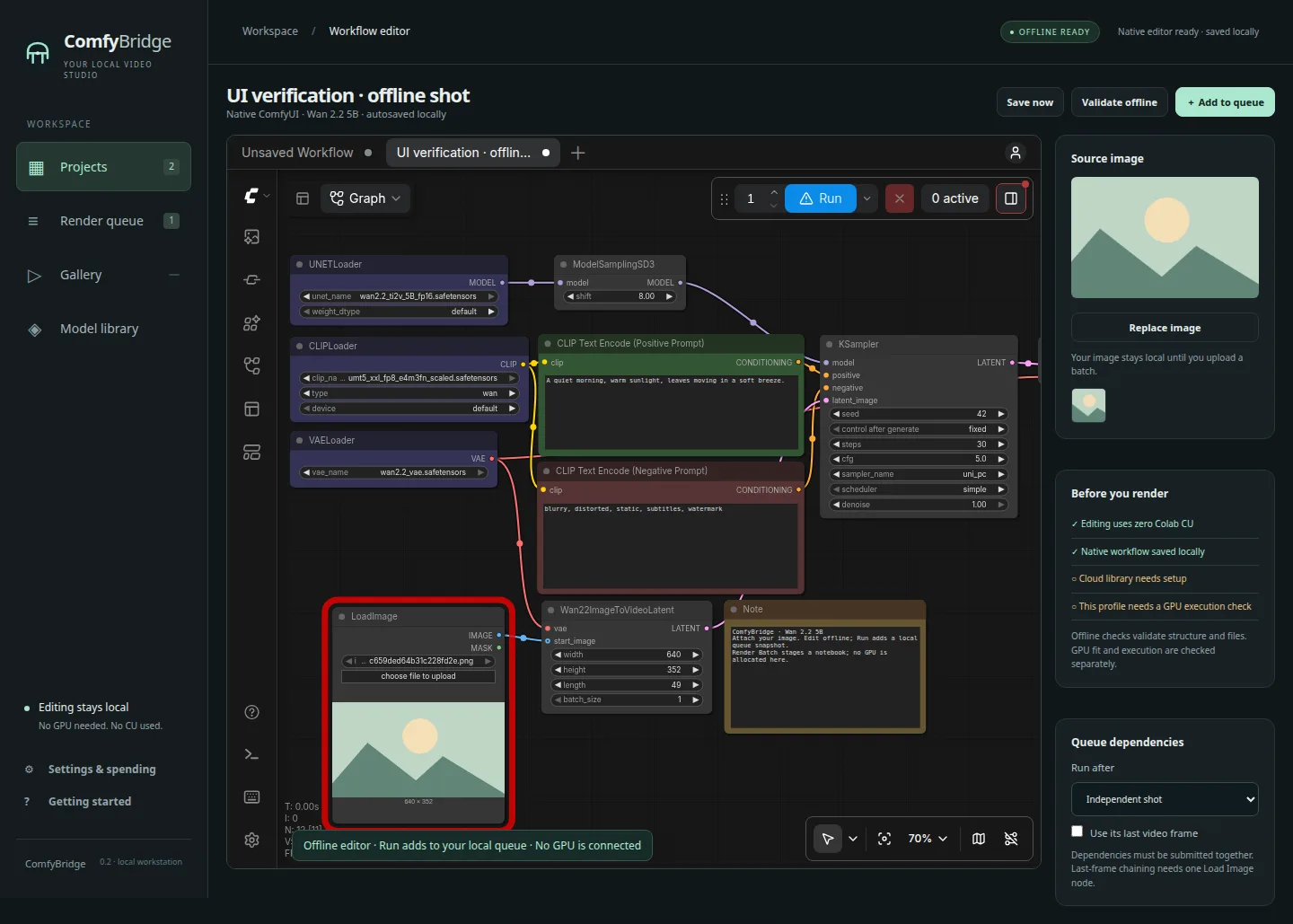
ComfyBridge is a local video workstation for my Linux laptop. It embeds the native ComfyUI editor, so I can build and tweak image-to-video workflows with no GPU, no model weights and no network. Work autosaves, and “Add to queue” takes an immutable snapshot of the workflow.
When a batch is ready, the app checks dependencies, checksums and spending settings, uploads it, and only after I explicitly approve compute does it start a Google Colab GPU. Results come back through Drive, verified, into a local gallery with the exact prompt, seed and model hashes. Model weights are fetched by a separate CPU session straight into Drive, one file at a time, each hashed on the way. Several watchdogs try to make sure a forgotten GPU does not keep billing, and the README says plainly which of them have not been tested under real failure.
The first real test rendered a Wan 2.2 14B preview on an A100 and used 0.887 compute units in total, under the 5-unit ceiling I had set. The editor and engine are ComfyUI’s (GPL-3.0); the video models belong to their authors.
GPU control center
My home GPU server already had a job broker and ComfyUI queues. Instead of adding yet another scheduler, I wrote a small installable web app that reads them: what the GPU is doing right now, which job and which agent own it, live resources, the true queue order and a playable history. It labels every number as recorded, inferred or estimated, and it does not invent progress bars.
EMA TTS Studio
A small web app that sends Turkish text from my laptop to the EMA Lightning speech model running on that GPU, then downloads, archives and plays the result. The model is someone else’s work, trained for Turkish; my part is the studio around it, with search, favourites and a metadata file next to every clip.
Where it stands
ComfyBridge and the TTS studio work end to end on my own machines. The control center is the newest piece, built against a recorded snapshot of the server and rolled out in small, reversible stages.