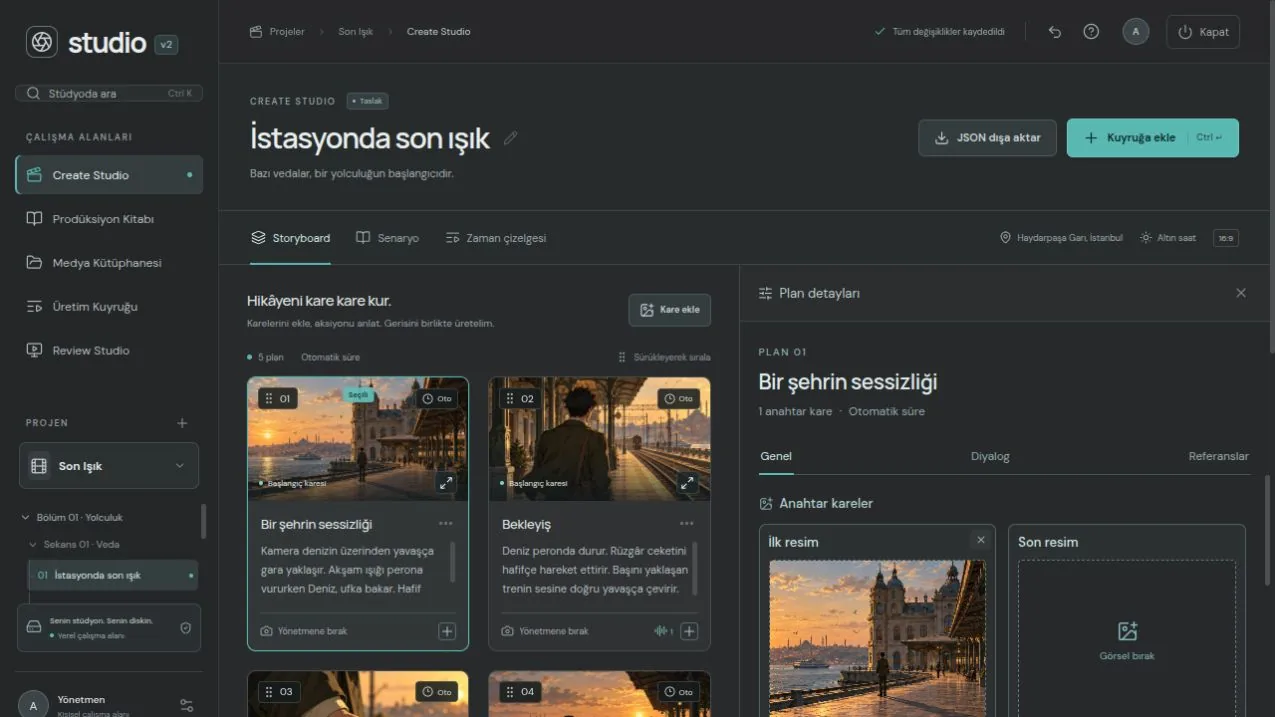
What it is
Studio v2 is the workspace where I direct anime with AI. I am not trying to type a prompt and hope for the best. The idea is to keep a director in charge. I bring the images, describe the action in Turkish and record the dialogue in my own voice. The studio’s job is to turn those decisions into finished shots without quietly changing them.
It runs locally as a desktop app. I double-click an icon, the studio opens in the browser, and everything (projects, media, versions) stays on my own disk.
How it works
A scene is built visually in Create Studio: drop in keyframes, order the shots, set the camera, duration and continuity, and attach dialogue. When it’s ready, “Kuyruğa ekle” (add to queue) validates the scene and freezes it as an immutable JSON production spec. Nothing downstream can drift from what was approved.
The production work itself is done by an AI coding agent, Claude Code, which reads the queue rather than living inside the app as a chatbot. It turns each spec into a technical plan and sends the shots to a video model on my home GPU, or to Google Colab, but only after an explicit budget approval. The rendered frames come back hash-verified, and FFmpeg assembles a review film. Then it’s my turn: in Review Studio I watch each version, pin notes to a timecode, and approve it or send it back. Earlier versions are never thrown away.
The film it’s making
The first real production is an adaptation of Halâs, a novel by Mehmet Rauf, which is now in the public domain. Its first two scenes have gone through many versions and are waiting for my review. The target is a director-approved 4K, 24 fps master. Final segments render at the model’s native resolution, and any 4K step has to be a real, faithful upscale, never a fake one.
Why it matters to me
Studio v2 is my attempt to use AI the way a film crew is used: many hands, one director, and a clear record of every decision.