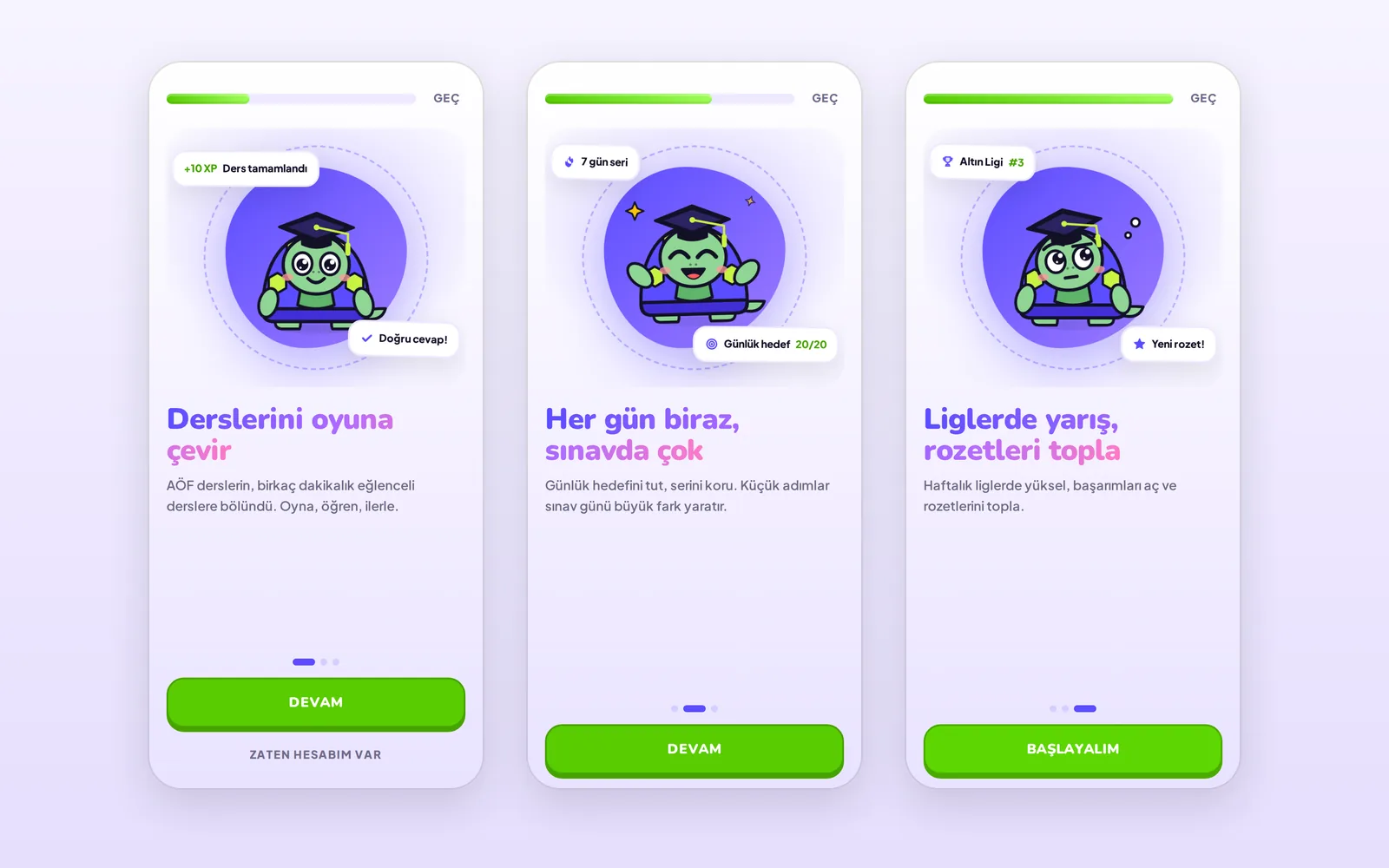
What it is
akadio is a Turkish learning app for students of Anadolu University’s Open Education Faculty (AÖF). Studying on your own, the hardest step is often just getting started. akadio borrows the habits that make language apps sticky and points them at university courses: a few minutes a day, short lessons, a streak you don’t want to break.
You pick your programme and courses, set a daily goal and start playing. Each lesson is a handful of questions in one of five formats: multiple choice, true or false, fill in the blank, matching and ordering. The courses on the path today include ATA101, TDI101 and BIL101, and most recently question banks for the AI-Supported Coding programme.
The game around the learning
A wrong answer costs a life, and lives refill over time. Streaks can be frozen or repaired. Gems buy small helpers in the shop. Weekly XP leagues promote and relegate, though for now your rivals are bots. Daily and monthly quests, a timed Quick Round, achievements and a profile with an activity calendar and an XP chart round it out. Aki, the mascot, cheers along the way.
How it’s built
The part I care about most is invisible. Every rule (XP, lives, streaks, quests, leagues, achievements, the shop) lives in a pure TypeScript core that never touches the DOM or the clock directly. Time is passed in, which makes every rule testable and deterministic, and the same engine can drive a mobile app later. The interface only calls into the core. Browser-specific code is kept to one small platform layer.
The web app is React 19 with Vite 7 and a hand-made CSS design system. It installs as a PWA, works offline after the first visit and is ready for Capacitor packaging on Android and iOS.
Where it stands
akadio is live at alicanzade.com/akadio. AÖF students come first. Content for high school and primary school students is planned for later stages.